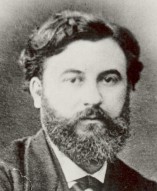
Eadweard Muybridge was born on the 9th April 1830
at Kingston upon Thames. He then
later passed away on the 8th May
1904. He was an English photographer important for his pioneering work in
photographic studies of motion, an early work in motion-picture projection.
At the age of 20, he emigrated to America, first to New York
as a bookseller, and then to San Francisco. He returned to England in 1861 and
took up professional photography, learning the wet-plate collodion process.
Today Muybridge is known for pioneering work on animation
locomotion in 1877 and 1878, which involved using multiple cameras to capture
motion in stop-motion photograph. He created a device called the zoopraxiscope
which projects motion pictures that pre-dated the flexible perforated film
strip used in cinematography.
Thomas Edison and George Eastman
George Eastman was born on the 12th July 1854 and
died on March 14th 1932. Eastman was an American entrepreneur who
founded the Eastman Kodak Company and populated the use of roll film, helping
to bring photography to the mainstream. Roll film was also the basis for the
invention of motion picture in 1888 by the world’s first film-makers Eadweard
Muybridge and Louis Le Prince. Eastman was the inventor who originally created
celluloid film.
Eastman worked closely with Thomas Edison who is considered
to be America’s greatest inventor. Edison was born on February 11th
1847 and died on October 18th 1931. Eastman and Edison worked
together to invent the first motion picture camera.
Edison’s laboratory was responsible of the Kinetograph (a
motion picture camera) and the Kinetoscope (a peep-hole motion picture viewer).
Most of this work was performed by Edison’s assistant. William Kennedy and
Laurie Dickson, beginning in 1888. Motion pictures became successful
entertainment industry in less than a decade, with a single viewer Kinetoscopes
giving way to films projected for mass audiences.
"I am experimenting upon an instrument which does for the
eye what the phonograph does for the ear, which is the recording and
reproduction of things in motion ...."
A phenakistoscope was an early animation device that used the
persistence of vision principle to create an illusion of motion. The
phenakistoscope consisted of two discs mounted on the same axis. The first disc
has slots around the edge, and the second contained drawings of successive action,
drawn around the disc in concentric circles. When the phenakistoscope spins
together in the same direction, the mirror shows the first disc’s slots, and
then the pictures on the second disc will appear to move. In 1832, Belgium physicist Joseph Plateau and his sons
introduced the phenakistoscope.
There were two different types of illusions that two
different people created the phenakistoscope was created in 1832 by Plateau
which used mirrors to create the illusion of movement by earlier the Michael
Faraday’s Wheel was created which consisted of two discs that spun in opposite
directions which again created the illusion of movement.
Joseph Plateau Joseph Plateau was born on the 14th of October 1801 and passed away at the age of 81 on the 15th of September 1883. He was a Belgian physicist and was one of the first persons to demonstrate the illusion of a moving image. His father was born in Tournai, and was a talented flower painter. At the age of six Plateau was able to read and made him a child prodigy in those times. While attending the primary schools, he was particularly impressed by a lesson of physics, and enchanted by the seen experiements, he promised himself to penetrate their secrets sooner or later. On 27th August 1840 he married Augustine-Therese-Aimee-Fanny Clavareau. A year after marriage they had a son in 1841.
ZOETROPE
A zoetrope is a 19th century optical toy consisting of a
cylinder with a series of pictures on the inner surface that, when viewed
through the slits with the cylinder rotating, gives an impression of continuous
motion.
The very first zoetrope was invented in China by a man
named Ding Huan in 180 AD. The modern zoetrope was invented in 1934 by William
Horner, who originally called it Daedalum (Wheel of the Devil).
It was based on Plateau’s phenakistoscope, but was more convenient
since it did not require a viewing mirror and allowed more than one person to
use it at the same time.
William Horner William George Horner was born on 9th June 1786 and died on the 22nd of September 1837. He was a British Mathematician; he was a schoolmaster, headmaster and school keeper, proficient in classics as well as mathematics, who wrote extensively on functional equations, number theory and approximation theory, but also on optics.
He and his wife Sarah (1787-1864) had six daughters and two sons.
PRAXINOSCOPE
The praxinoscope was an animation device, and is similar to the zoetrope.
It uses a strip of pictures placed around the inner surface of a spinning
cylinder. The praxinoscope has mirrors in the middle with frames at the side
that’s been placed inside a shallow outer cylinder, to see the movement of the
animation you have to spin it and look at the mirrors. The number of mirrors
are actually equal to the number of pictures so the images of pictures are
viewer in the mirrors. The reflected pictures gives an illusion of moving
pictures, when the outer cylinder rotates. It was invented in 1877 by Charles-Emile Reynaud.
The praxinoscope was better than the zoetrope because
each mirror the praxinoscope projected showed a clear image opposed to it,
whereas the zoetrope lost a lot of luminosity in the movement whereas the
praxinoscope. Reynaud adapted the praxinoscope so it could be projected whereas
the zoetrope couldn’t be. The replacement of the opaque drawings with
transparent drawings meant that light could be shone through them.
The praxinoscope was developed for theatrical
entertainment by painting a series of pictures on small glass plates which were
joined together in a single flexible strip. The animated characters were
projected onto a screen from behind.
Charles-Emile Reynaud Charles-Emile Reynaud was on on the 8th December 1844 and died on the 9th January 1918. He was a French inventor, responsible for the praxinoscope. His Pantomimes Lumineuses was premiered on 28th October 1892 in Paris. His Theatre Optique film system, patented in 1888, is also notable as the first known instance of film perforations being used.
The Phi Phenomenon is when our brains create the sense of
movement with an animation or a motion picture. It was first described by Max
Wertheimer in 1912. The human brain can perceive about 10 – 12 fps, anything
higher our brains blend the images together.
What is the
significance of 12fps?
12fps was the first frame rate. Playing back 12 frames per
second with 12 intermittent periods of black as the film advances will create
an intolerable amount of flicker. To make the flicker of black Thomas Edison
says the number is 46 frames per second.
What is
over-cranking?
Over-cranking is recording a faster frame rate than final
projection.
What is
under-cranking?
Under-cranking is recording a slower frame rate than final
projection.
What impact did
the introduction of sound have on frame rate?
Sound was a huge technological achievement that changed film
in a drastic way. Frame rate had to be kept at a strict frame rate and that was
established in 1929 as 24 frames per second. It was 24 frames per second
because the sound track didn’t have the fidelity on a 16 frames per second
system. They used a 24 frame per second projection using a double bladed
shutter to keep to desired 48 projected frames per second.
Give as much
rationale as you can for why 24 became the international frame rate
24fps became the international frame rate because it was
cheapest option rather than going to 30 or 32fps.
What issues
surrounded bandwidth?
The issues that surrounded bandwidth was that the bandwidth
used by the colour subcarrier which could potentially interfere with the audio
signal causing intermodular beating. The solution to this would be to reduce
the frame rate by 0.1% so this made frame rate 29.97fps.
What was
interlacing?
Interlacing is when the picture it split into the upper
field and lower field. Each field would be created on the screen one after the
other in a comb like pattern.
How was the
challenge of intermodulation tackled?
In order to beat intermodulation, or a beating distortion
caused by the hum generated in the electrical current, the refresh rate was set
to that of the AC power – in the United States, 60 hertz.
What is the
significance of 60 hertz and how does it relate to 30 frames per second?
60 hertz equals to 60 frames per second. By this the screen
will have a full 30 frames per second.
What is the
difference between VHF and UHF?
VHF (30-300 MHz) was the old black and white television sets
and UHF (300 – 3,000 MHz) was trying to introduce colour to the television
sets.
How was colour
standard arrived at?
The would break down the colour into luminance and
chrominance, broadcasters could embed a colour signal as a subcarrier in the
television signal. New colour TVs could pick up and interpret this colour
subcarrier which would be ignored by the older black and white TV sets.
What challenge did
bandwidth present to achieving a colour standard and how was this problem
overcome?
The bandwidth used by the colour subcarrier could
potentially interfere with the audio signal causing intermodular beating. The
solution to this would be to reduce the frame rate by .1% phasing the colour
and audio signals so they would never fully match up.
What was the
fields per second ratio that was eventually developed as the standard in colour
and what was the resulting frames per second ratio?
The go from 60 fields per second down to 59.94 fields per
second and 29.97 full frames per second.
What is PAL and
why was it developed?
PAL was a format to solve the colour problems that plagued
NTSC and would work with the 50 Hertz AC power used in Europe and everywhere
else in the world.
What are the
fields per second and frames per second ratios of PAL and SECAM?
PAL along with a similar format run at 50i for an effective
25 frames per second.
A) Produce a step by step guide to explain
how we get from the 24 frames per second of film to a 60i video stream to be
able to watch celluloid movies on video?
First of all, the 24 frames per second film is slowed down
by 0.1% giving up 23.976 frames per second.
If we need to make 4 frames of 23.976 to fit into 5 frames
of 29.97. They did this by splitting the frames into fields using a
3:2 pull-down.
The first frame is captured onto three fields – the upper, lower
and then upper field – that’s one and one half frames. The next frame is
captured on the following two fields, lower field and then upper.
The next
frame after that fills up the lower, then following upper and lower with the
last frame filling the upper and lower field.
B)What are the issues with the various
conversions?
This still resulted in video streaming having Telecine
judders every 3 frames which is especially noticeable on long slow camera
movements.
How does modern
digital camera avoid the telecine process and with what effect?
Modern digital camera avoided the telecine process as they
record 23.976 or straight 24 frame rates natively on to the hard drive but
there are some workflows that run through HDMI cables which are rated for 60i.
How are 24fps
films telecining onto SECAM or PAL fps?
For telecining film onto PAL or SECAM’s the process was much
simpler. They used a 2:2 pulldown, the 24 frames per second footage was sped up
by 4% and each frame is transferred onto two fields – an upper and a lower
field. The increased speed raises the pitch of the audio by a noticeable 0.679
semitones or a little more than a quarter.
Explain high frame
rates and temporal resolution
24fps has been the standard for narrative film for nearly a
century now. But enterprising filmmakers have tried to push temporal resolution
or frame rate higher – trying to reduce the motion blur to create smoother and
more realistic look to the film.
What are the
issues with higher frame rates in narrative filmmaking?
Audiences have warmed up to high frame rates in narrative
filmmaking, the most recent example of a film with high frame rates is Peter
Jackson’s ‘The Hobbit’. This film was shot in 48 frames per second and
audiences did not agree with how it looked, they complained that the “human
actors seemed over-lit and amplified”, another reviewer complained that “it
looked like a made-for-TV movie”. Filmmakers like Peter Jackson or James
Cameron, push for higher frame rates.
Stop Motion Animation is the technique used to make
static objects come to life on screen. This is done by moving the object ever
so slightly between each frame and a picture is taken on every piece of
movement. When you play the images in rapid succession it will make the
illusion of movement.
Film
Wallace and
Gromit: The Curse of the Were-Rabbit – When the creators were creating
Wallace and Gromit: The Curse of the Were-Rabbit they used clay figures and
moved them ever so slightly and took a picture of that small movement. They did
this throughout the whole film and then played in rapid succession it makes the
illusion of movement which created Wallace and Gromit.
Fantastic Mr. Fox
– Fantastic Mr. Fox was created using the same form of animation than
Wallace and Gromit. This was done when a small movement is taken a picture of
and keeping taking pictures of the small movement performed and then put
together in rapid succession of each other to create an illusion of
movement.
TV
Postman Pat – Postman Pat was done using clay stop motion animation. This was done by the creators making figurines out of clay and moving them ever so slightly in each frame taken. This will create an illusion of movement when the pictures are put into rapid succession of each other.
Persistence of vision is the optical illusion that occurs
when a visual perception of an image can be substituted for another with the
other image slightly different and then the illusion of movement is created.
The
thaumatrope and roller worked because they are an optical illusion of where one
image can be substituted for another with the other image slightly different
and when the action used on the thamatrope and roller it creates the illusion
of movement.
Thaumatrope I made a thaumatrope and it created a very basic animation. The image on my thaumatrope is a stick man walking. When you twist the
elastic band slowly you cannot see the animation, whereas if you twist it fast
you can see the animation more clearly.
It only does the animation that is drawn which is a very simple
movement whereas with an animated film you see loads of movement and actions.
·The thaumatrope is an animation because it is an illusion of movement
which uses photography to show that the stick man is moving when really it
isn’t. Roller For my first roller it was a robot wanting to jump then
in the second image it is him jumping. When I roll the paper faster you will
see the animation a lot clearly then it being slower. The roller I used was a smiley face but as you rolled it,
it changed to a bigger smile with small features on the face that has changed. A roller is an animation because they are an illusion to the eye. You have two images the same and when the action is completed it looks like that the images are moving.
Animation
is the illusion of movement which uses photography to allow images to capture images which are then made to move in rapid succession when edited or projected.
Different Types of Animation:
Drawn / Cell Animation:
Drawn
animation is the method of creating hand-drawn animation. Individual frames are
drawn in a sequence that, when played back quickly creates the illusion of
continuous movement.
Example: Pinocchio (1940)
Stop Motion / Model Animation:
Stop motion animation is animation that is captured one frame at a time, with physical objects that are moved between frames. When you play back the sequence of images rapidly, it creates the illusion of movement.
Example: Corpse Bride (2005)
Computer Generated Animation:
Computer
generated animation is the process used for generating animated images. Computer
generated animation encompasses both static scenes and dynamic images, while
computer animation only refers to the moving images.
Example:
The Adventures of Tintin: The Secret of the Unicorn (2011)
 Eadweard Muybridge was born on the 9th April 1830
at Kingston upon Thames. He then
Eadweard Muybridge was born on the 9th April 1830
at Kingston upon Thames. He then