PHENAKISTOSCOPE
A phenakistoscope was an early animation device that used the
persistence of vision principle to create an illusion of motion. The
phenakistoscope consisted of two discs mounted on the same axis. The first disc
has slots around the edge, and the second contained drawings of successive action,
drawn around the disc in concentric circles. When the phenakistoscope spins
together in the same direction, the mirror shows the first disc’s slots, and
then the pictures on the second disc will appear to move. In 1832, Belgium physicist Joseph Plateau and his sons
introduced the phenakistoscope.
There were two different types of illusions that two
different people created the phenakistoscope was created in 1832 by Plateau
which used mirrors to create the illusion of movement by earlier the Michael
Faraday’s Wheel was created which consisted of two discs that spun in opposite
directions which again created the illusion of movement.

Joseph Plateau was born on the 14th of October 1801 and passed away at the age of 81 on the 15th of September 1883. He was a Belgian physicist and was one of the first persons to demonstrate the illusion of a moving image.
His father was born in Tournai, and was a talented flower painter. At the age of six Plateau was able to read and made him a child prodigy in those times. While attending the primary schools, he was particularly impressed by a lesson of physics, and enchanted by the seen experiements, he promised himself to penetrate their secrets sooner or later.
On 27th August 1840 he married Augustine-Therese-Aimee-Fanny Clavareau. A year after marriage they had a son in 1841.

ZOETROPE
A zoetrope is a 19th century optical toy consisting of a
cylinder with a series of pictures on the inner surface that, when viewed
through the slits with the cylinder rotating, gives an impression of continuous
motion.
The very first zoetrope was invented in China by a man
named Ding Huan in 180 AD. The modern zoetrope was invented in 1934 by William
Horner, who originally called it Daedalum (Wheel of the Devil).
It was based on Plateau’s phenakistoscope, but was more convenient
since it did not require a viewing mirror and allowed more than one person to
use it at the same time.

William George Horner was born on 9th June 1786 and died on the 22nd of September 1837. He was a British Mathematician; he was a schoolmaster, headmaster and school keeper, proficient in classics as well as mathematics, who wrote extensively on functional equations, number theory and approximation theory, but also on optics.

PRAXINOSCOPE
The praxinoscope was an animation device, and is similar to the zoetrope.
It uses a strip of pictures placed around the inner surface of a spinning
cylinder. The praxinoscope has mirrors in the middle with frames at the side
that’s been placed inside a shallow outer cylinder, to see the movement of the
animation you have to spin it and look at the mirrors. The number of mirrors
are actually equal to the number of pictures so the images of pictures are
viewer in the mirrors. The reflected pictures gives an illusion of moving
pictures, when the outer cylinder rotates. It was invented in 1877 by Charles-Emile Reynaud.
The praxinoscope was better than the zoetrope because
each mirror the praxinoscope projected showed a clear image opposed to it,
whereas the zoetrope lost a lot of luminosity in the movement whereas the
praxinoscope. Reynaud adapted the praxinoscope so it could be projected whereas
the zoetrope couldn’t be. The replacement of the opaque drawings with
transparent drawings meant that light could be shone through them.
The praxinoscope was developed for theatrical
entertainment by painting a series of pictures on small glass plates which were
joined together in a single flexible strip. The animated characters were
projected onto a screen from behind.

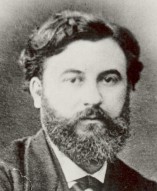
Charles-Emile Reynaud
Charles-Emile Reynaud was on on the 8th December 1844 and died on the 9th January 1918. He was a French inventor, responsible for the praxinoscope. His Pantomimes Lumineuses was premiered on 28th October 1892 in Paris. His Theatre Optique film system, patented in 1888, is also notable as the first known instance of film perforations being used.

No comments:
Post a Comment